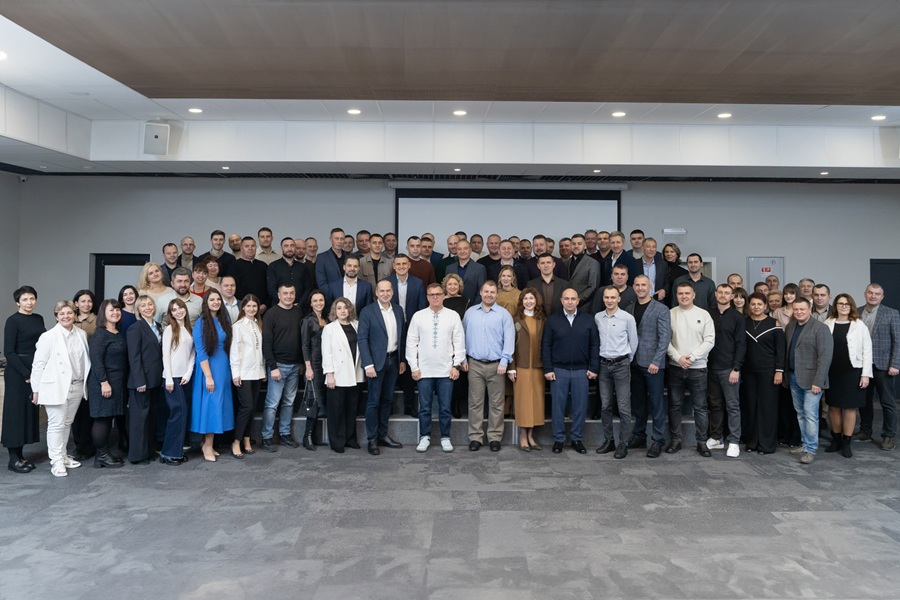
On the occasion of NIBULON’s 34th anniversary, the company held its annual General Meeting, during which heads of the departments reviewed 2025 results and shared plans for 2026. Despite the challenges of war, market uncertainty, climate change, and new restrictions, NIBULON continues to operate resiliently, responsibly, and with a focus on the future.
Finance Department: Open discussion of challenges and a systematic approach to solutions

Mykyta Hrubov, Chief Financial Officer of NIBULON, emphasized that despite losses, the company remains focused on responsibility and growth:
“Even in times of war, we continue to meet our obligations as a responsible employer, borrower, conscientious taxpayer, and corporate citizen. Today, NIBULON operates with a stabilized model that allows us to generate profit, transform the business, and safeguard financial stability. Over the years of the war, we have paid $156 million in loan interest, $67.5 million in taxes, and invested nearly $73 million in critical areas of enterprise development and efficiency improvement.”
However, NIBULON faced a reality that reshaped both the market and its business model: the loss of logistical advantages, destruction and occupation of assets, climate anomalies in the southern regions of the country, and the unchanged debt burden that existed even before the war.
“In 2025, we successfully restructured almost our entire loan portfolio. Yet with the Mykolaiv terminal and fleet blocked, nearly all available funds are directed to interest payments. This ensures short-term stability but does not provide a comprehensive long-term solution for all stakeholders. That is why we have engaged a financial advisor and are beginning to develop a new balanced approach to debt structure and servicing terms that will align the interests of both our creditors and the company.”
Trade Department: Forced low margins, but significant transformation

Volodymyr Slavinskyi, Director of Trade, described the situation as the most challenging in recent years:
“Low yields in the South, harvest delays in the North, war. But the biggest challenge is competition, both within the domestic market and internationally. We have lost margin, but not initiative.”
NIBULON has updated its commercial approach: a refreshed trading strategy, a strengthened team, and an International Desk established to focus on global trading operations and market diversification. Digitalization has become a key tool in this transformation. The company launched the NIBULON App, a platform for farmers that combines service convenience, commercial transparency, and partner support.
“We are redefining the role of the trader—from a simple buyer to a true partner. The first 1,000 farmers are already working with us under the new model. This is about service, trust, and long-term collaboration.”
In 2026, the team expects even greater results from the implemented changes and is confidently preparing to open a new chapter in NIBULON’s history as a next-generation trading company.
Logistics: Not just surviving, but expansion

Serhii Kalkutin, Director of Logistics, called the situation in the industry critical:
“The war is having a systemic impact on logistics — shelling, long queues, restrictions, and a shortage of railcars. We are responding systematically: increasing the share of our own transport, utilizing capacities by providing services to external partners, and already expanding fleet operations beyond Ukraine. Our goal is a flexible and independent logistics model that can remain profitable even during a crisis.”
Agricultural Production Department : Growing despite losses

Oleg Veselov, Director of Agricultural Production, admitted that this year has been the most challenging in the past decade.
“After the destruction of the Kakhovka Dam, the South practically lost its traditional advantages. Heavy rains in the North added further challenges. Yet we maintained our results: $329/ha — and that’s in wartime conditions.”
The company has returned 7,500 hectares of demined land to cultivation. In terms of crop structure, Oleg noted that the company is moving toward increasing the share of corn while reducing the share of soy. In the South, they are actively exploring spring crop options as potential substitutes for sunflowers.
“The future of our company is in technology. We’ve implemented digital production management, enhanced our agri-analytics, and are focused on boosting profitability even in the face of changing climate conditions.”
Elevator: Efficiency in a new reality

This year, NIBULON’s elevator department not only withstood the challenges but also demonstrated adaptability, investing in modernization, digitalization, and new approaches to quality.
“This year tested not only our professionalism but also our ability to respond quickly to external and internal challenges, make decisions, and recover. We invested where it was necessary, digitalized our processes, and set the direction for the industry’s future development,” said Valerii Reutsoi, Director for Elevators Operations.
Among the key achievements of 2025 was the development of infrastructure for loading coaster-type vessels at the Bessarabska branch, with 40 vessels successfully shipped. The elevators achieved full energy independence thanks to the active operation of generators. Paperless document flow and operator-free weighing systems were introduced, reducing human error, improving accuracy, and saving up to $145,000 per year in labor costs. The quantitative and qualitative accounting was fully automated, covering weighing, incoming and outgoing shipments, inventory, internal transfers, and laboratory services. This automation restored NIBULON elevators’ status as a benchmark for quality in the market. In addition to technological breakthroughs, we updated our pricing policy:
“Together with the Trade Department, we reviewed the discount system for suppliers. The result was a 61% reduction in grain returns,” said Valerii Reutsoi.
These achievements reflect a systematic focus on quality control, well-defined procedures, and automation of core business processes.
2025 showed that NIBULON is a system that keeps running even in extreme conditions, with every department playing its part in delivering results.

IT Department: From a support function to a driver of company transformation. Key business processes in trading, logistics, agriculture, HR, finance, and procurement have been automated. SCADA and WMS systems were launched, AI agents for document verification implemented, IT infrastructure modernized, and cybersecurity strengthened. In 2026, the focus will be on a fully digital business management model.

Technical Department: has secured the infrastructure’s energy independence, launched green power generation, automated cost accounting, and carried out the company’s first-ever independent CO₂ emissions assessment. Everything is aimed at efficiency, transparency, and environmental accountability.

HR Department: Maintained team stability, expanded the KPI system, and provided training for almost 900 employees. Meanwhile, the employee Net Promoter Score (eNPS) rose from -9.2 to +3.1.

Legal Department: Doubled the volume of processed requests, automated contract management, streamlined the corporate structure, and initiated preparations for international claims processes related to war-related losses.

Procurement Department: Completed key stages of purchase automation, prepared processes for electronic approvals, and laid the foundation for creating transparent regulations in 2026.

Security Department: Redefined its role from a protective function to a business partner. Implemented technical security pilots, reduced costs by UAH 27 million, introduced AI for verification and accreditation, and increased overall unit efficiency.
Together we keep the Grain`s Captain course
Even in the extremely challenging conditions of wartime, NIBULON maintains not only stability but also a strategic vision: investing in digital transformation, modernization, ESG, team development, community support, and partnerships with farmers.
This is the course of the Grain`s Captain – a course we keep together.